Why Can’t You Put Your Phone Down?
You open Instagram “just to check something quickly” and, suddenly, an hour has gone by. Sound familiar? 🤯
It’s no coincidence. Apps are designed to keep you using them for longer than you realize. Behind every notification, color, and animation, there are psychological techniques designed to keep you engaged. And most of the time, we’re barely aware of them.
In this article, we’ll uncover some of the tricks apps use to keep you glued to your screen.
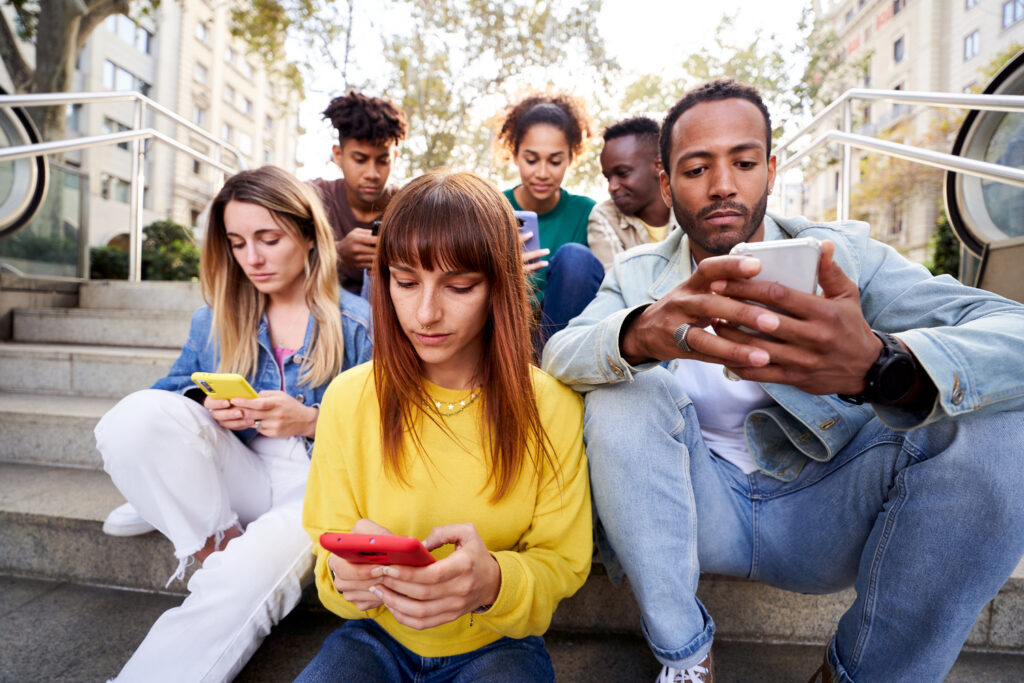
Group of young people using their smartphones excessively, affecting face-to-face social interaction.
1. Red notifications: the color that grabs your attention
Notifications are often red. And that’s not just an aesthetic choice.
📌 Red naturally draws our attention and is often associated with urgency. It’s the same color commonly used for warning signs, alerts, and errors because it stands out and encourages us to react quickly.
If notifications were blue or green, they might be easier to ignore. But when you see that little red badge on your screen, you’re more likely to feel the urge to check what’s waiting for you.
👉 How to avoid it: turn off unnecessary notifications and consider switching your phone to grayscale mode to make those visual cues less attention-grabbing.
2. Infinite scroll: there’s always something else to see
Social networks and many content-based apps use infinite scrolling, which means you never actually reach the end of the page.
🎰 It works a little like a slot machine.
Every time you scroll, your brain expects that the next piece of content might be interesting. Even when it isn’t, you keep going, hoping to find the next great post, video, or piece of content.
This is related to what psychologists call variable reinforcement: rewards appear unpredictably, encouraging us to repeat the same behavior.
👉 How to avoid it: set time limits for your apps or use tools that help you control how long you spend scrolling.
3. Likes and reactions: a reward system in your pocket
Every time you receive a like, comment, or positive notification, your brain’s reward system responds. Dopamine plays an important role in this process, particularly in motivation, anticipation, and reward-seeking behavior.
🧠 Why is this so powerful?
Because unpredictable social rewards can encourage us to check our phones again and again. You post something, receive a few likes, and then come back later to see whether there are any more.
Platforms are designed to encourage this kind of repeated interaction, using notifications and other cues to bring you back to the app throughout the day.
👉 How to avoid it: turn off notifications for likes and reactions, and try to use social media more intentionally instead of checking it automatically.
4. “Intentional” loading times
Sometimes, when you open an app or perform an action, you see a short loading screen. But not every delay is necessarily caused by technical limitations.
📌 In some digital experiences, small delays or animations can be used to build anticipation and make the result feel more significant.
🎯 For example: when an app makes you wait briefly before revealing a result, that pause can increase suspense and make the interaction feel more exciting.
It follows a similar psychological principle to games of chance: the anticipation of the result becomes part of the experience itself.
👉 How to avoid it: simply being aware of these design techniques can help. Not every pause, animation, or interaction is there purely for technical reasons.
Who’s using whom?
Apps are often designed to maximize engagement and the amount of time we spend using them. It isn’t magic: it’s a combination of psychology, behavioral design, and technology.
But once you understand how these techniques work, it becomes easier to recognize them and use apps more consciously.
Because sometimes, the hardest part of putting your phone down is realizing how much work has gone into making you pick it back up.